.png)

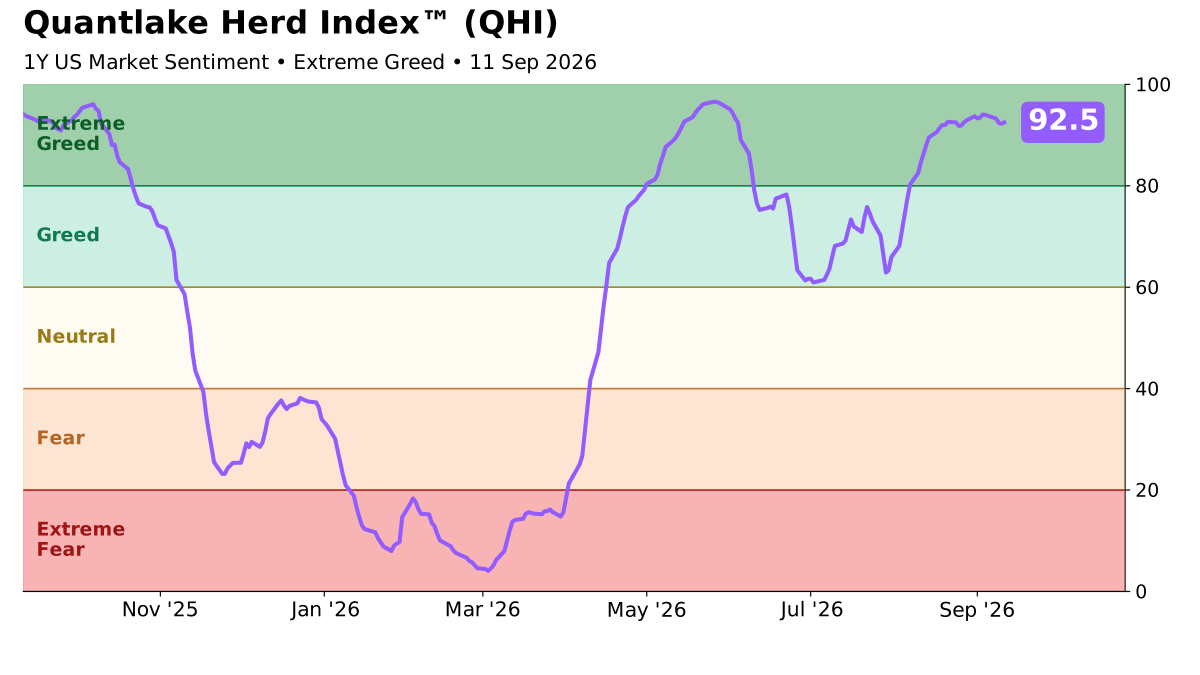
QHI Reading: Extreme Greed Persists, Optimism Holds Near Peak.
Extreme Greed Historically Cuts One-Month Win Rate to 57.7%
The Quantlake Herd Index (QHI) stands at 92.5 on September 11 after a 1.5-point pullback over the past five sessions and a 4.5-point rise over the past 20. The index sits 0.3% above its 1-month average of 92.2 and 62.7% above its 12-month average of 56.9. The 95.3rd-percentile reading and 0.96 position in the one-year range place sentiment near the upper bound, and QHI set a new 1-week high. The near-range-high reading defines an entrenched-optimism regime. Investor behavior is elevated, and short-term momentum is mixed.
Extreme Greed trims the forward edge for the SPDR S&P 500 ETF SPY and widens the downside tail. Across 818 Extreme Greed observations, the 1-month hit rate is 57.7% against a 69.0% baseline, the mean return is -0.2% versus 1.2%, and the Sharpe is -0.13 against 1.07. The 5th-percentile outcome reaches -8.1%, and the worst-5% average reaches -14.1%, compared with baseline readings of -6.1% and -9.6%. At three months, the mean gap is 1.7% versus 3.6%, the Sharpe is 0.48 against 1.19, and the tail extends to -13.4% on VaR5 and -16.0% on CVaR5, compared with -8.2% and -12.6% at baseline. The win-rate deficit and the heavier three-month tail define the contrarian profile attached to crowded risk appetite.
The Extreme Greed tenure has reached 25 trading days, or 1.18 times its historical average. The 1-month standard deviation stands at 1.4, or 0.2 times its historical average. The 25-day tenure and 0.2x volatility ratio describe entrenched optimism. Sentiment is high in the range, and day-to-day variation is muted.
Accessing Our Data
The full QHI historical series since September 1, 2009 is available via the Quantlake API for systematic integration. Learn more about the QHI methodology →
Data: 11 Sep 2026 · Daily Time Scale.
Romain Gandon
CEO, Quantlake
Disclaimer: This article is for informational and educational purposes only and does not constitute investment advice. Past performance is not indicative of future results.
Definitions
Quantlake Herd Index (QHI)
The Quantlake Herd Index (QHI) is a proprietary cross-asset behavioral sentiment composite ranging from 0 to 100 that measures extremes in investor psychology across the U.S. financial system.
It aggregates signals from U.S. equity momentum and breadth, equity market concentration dynamics, credit market risk appetite (high-yield vs investment-grade demand), implied volatility conditions, and credit spread behavior. These inputs are normalized into a single behavioral risk barometer reflecting the balance between risk-averse and risk-on investor behavior.
Because markets are influenced by behavioral biases, sentiment extremes frequently precede mean reversion in forward returns.
QHI Regimes
0–20: Extreme Fear
20–40: Fear
40–60: Neutral
60–80: Greed
80–100: Extreme Greed
Statistical Terms
Win Rate (Hit Ratio)
The percentage of historical periods in which SPY produced a positive return over the forward horizon. A win rate above 50% means positive outcomes historically dominated.
Median Return
The midpoint of the return distribution — 50% of outcomes fell above and 50% below this value. Less sensitive to extreme outliers than the average.
p25 / p75 (Expected Range)
The range within which the middle 50% of historical outcomes fell. p25 is the 25th percentile (bottom of the range); p75 is the 75th percentile (top). A tighter range indicates a more predictable regime; a wide range reflects high dispersion.
VaR 5% (Value at Risk)
The 5th-percentile return over the horizon — statistically, SPY has done worse than this figure only 5% of the time. A practical downside threshold: in 95 out of 100 historical observations, the actual outcome was better.
CVaR 5% (Conditional Value at Risk / Expected Shortfall)
The average of the worst 5% of historical outcomes. Where VaR 5% sets the threshold, CVaR 5% tells you what to expect on average when you are in that tail — a more complete picture of severe downside risk.
Full Range (min–max)
The absolute worst and best single-period outcomes recorded in the historical dataset. Useful as extreme-scenario context, but driven by one-off events (e.g. COVID crash, post-GFC recovery) rather than typical behaviour.
Sharpe Ratio
Annualised return divided by annualised volatility, measuring return per unit of risk. Higher values indicate better risk-adjusted performance in that regime.