.png)

Why a "Suboptimal" Strategy Still Wins Investors
The enduring appeal of dollar-cost averaging
Dollar-cost averaging has long occupied a curious place in investing. It is widely taught, frequently recommended, and deeply embedded in everyday investment practice. Yet, for decades, financial theory has argued that it falls short of a seemingly superior alternative. This tension between what the models prescribe and what investors actually do offers a revealing window into how real-world portfolios are built—not just with equations, but with human behavior.
Theoretical clarity meets practical resistance
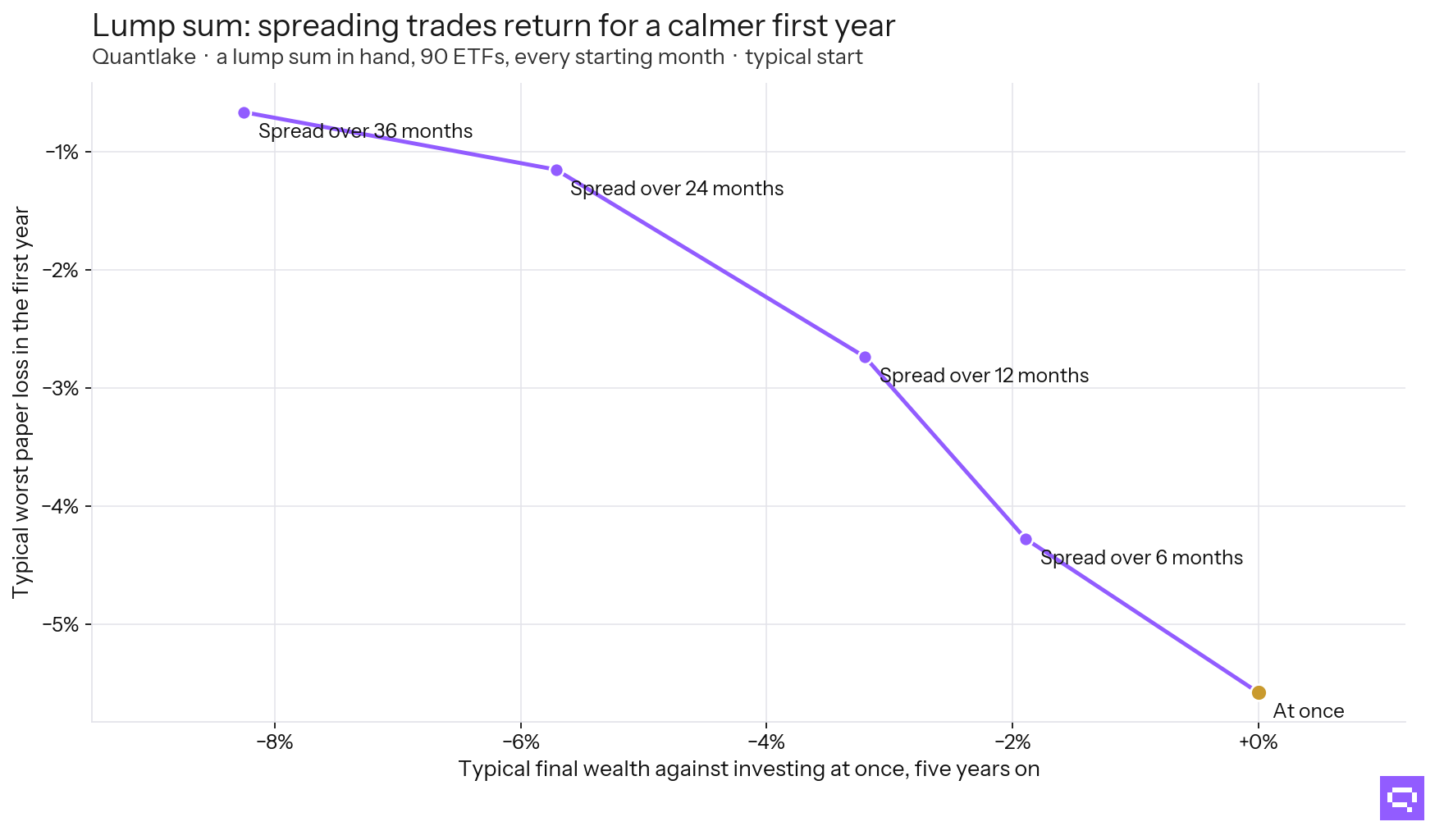
From the perspective of standard finance, the verdict on dollar-cost averaging is unambiguous. In a world where investors are fully rational and markets offer positive expected returns, delaying investment is costly. By keeping part of the capital sidelined, dollar-cost averaging lowers expected returns compared to investing the entire amount immediately.
This result was formalized by Constantinides (1979), who showed that, under these assumptions, dollar-cost averaging is a dominated strategy relative to lump-sum investing. The logic is clean and internally consistent. And yet, despite this theoretical clarity, dollar-cost averaging remains remarkably prevalent—used by individual investors, embedded in retirement systems, and endorsed by practitioners. The persistence of the strategy is therefore not a mathematical puzzle, but a behavioral one.
Behavioral finance explains what models overlook
The most compelling explanation for the resilience of dollar-cost averaging comes from behavioral finance, particularly the work of Meir Statman in A Behavioral Framework for Dollar-Cost Averaging (1995). Rather than judging the strategy solely on expected returns, Statman reframes it as a tool for managing the psychological frictions that often derail investment plans.
A central insight is the role of emotion—especially regret. Standard finance largely abstracts from feelings such as regret and pride, yet these emotions strongly influence investor behavior. A poorly timed lump-sum investment can generate acute regret, increasing the likelihood that an investor abandons the strategy altogether. Dollar-cost averaging diffuses this emotional burden across time, reducing the weight of any single decision and making the overall process more tolerable.
The strategy also serves as a defense against cognitive errors. Investors have a well-documented tendency to extrapolate recent market movements, buying after rallies and hesitating after declines. By committing to a fixed schedule, dollar-cost averaging limits the influence of short-term sentiment and prevents emotional reactions from dictating timing decisions (Statman, 1995).
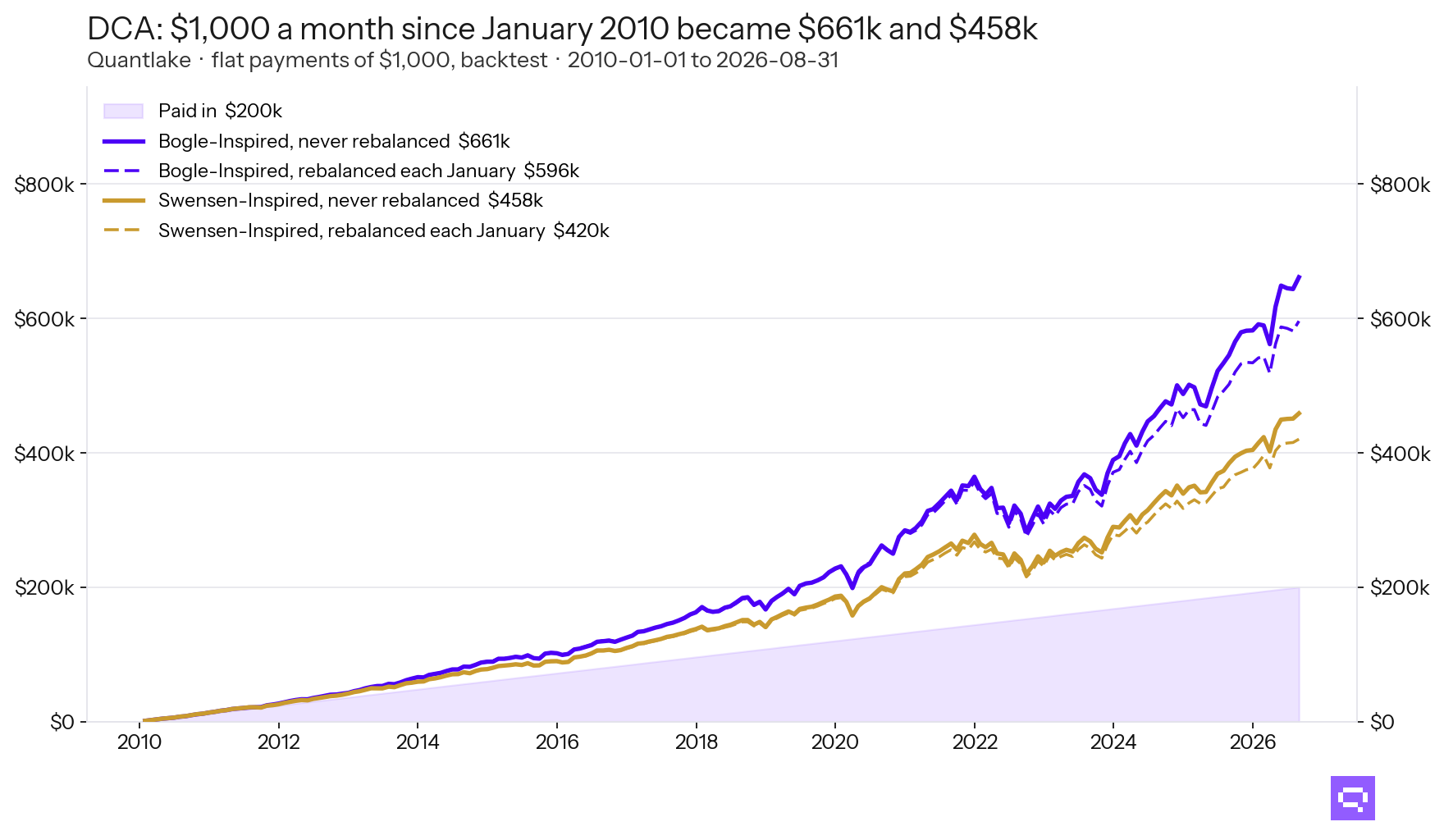
From a behavioral economics standpoint, dollar-cost averaging functions as a pre-commitment device. It enforces discipline during periods of market stress, when fear and uncertainty might otherwise lead to inaction or selling. This logic is implicitly built into defined-contribution retirement plans, where investments occur automatically with each paycheck, regardless of market conditions.
Finally, framing matters. Drawing on prospect theory (Kahneman & Tversky, 1979) and mental accounting (Thaler, 1985), Statman shows that investors perceive a sequence of smaller, regular investments very differently from a single, all-or-nothing decision. The former feels less risky and psychologically easier to sustain, even if it comes at the cost of lower expected returns.
Why "second-best" strategies often win
From our perspective at Quantlake, dollar-cost averaging should not be evaluated as a return-maximization tool. It is better understood as a mechanism for behavioral optimization—a "second-best" solution that helps investors cope with regret aversion, cognitive bias, and self-control problems that routinely undermine long-term plans.
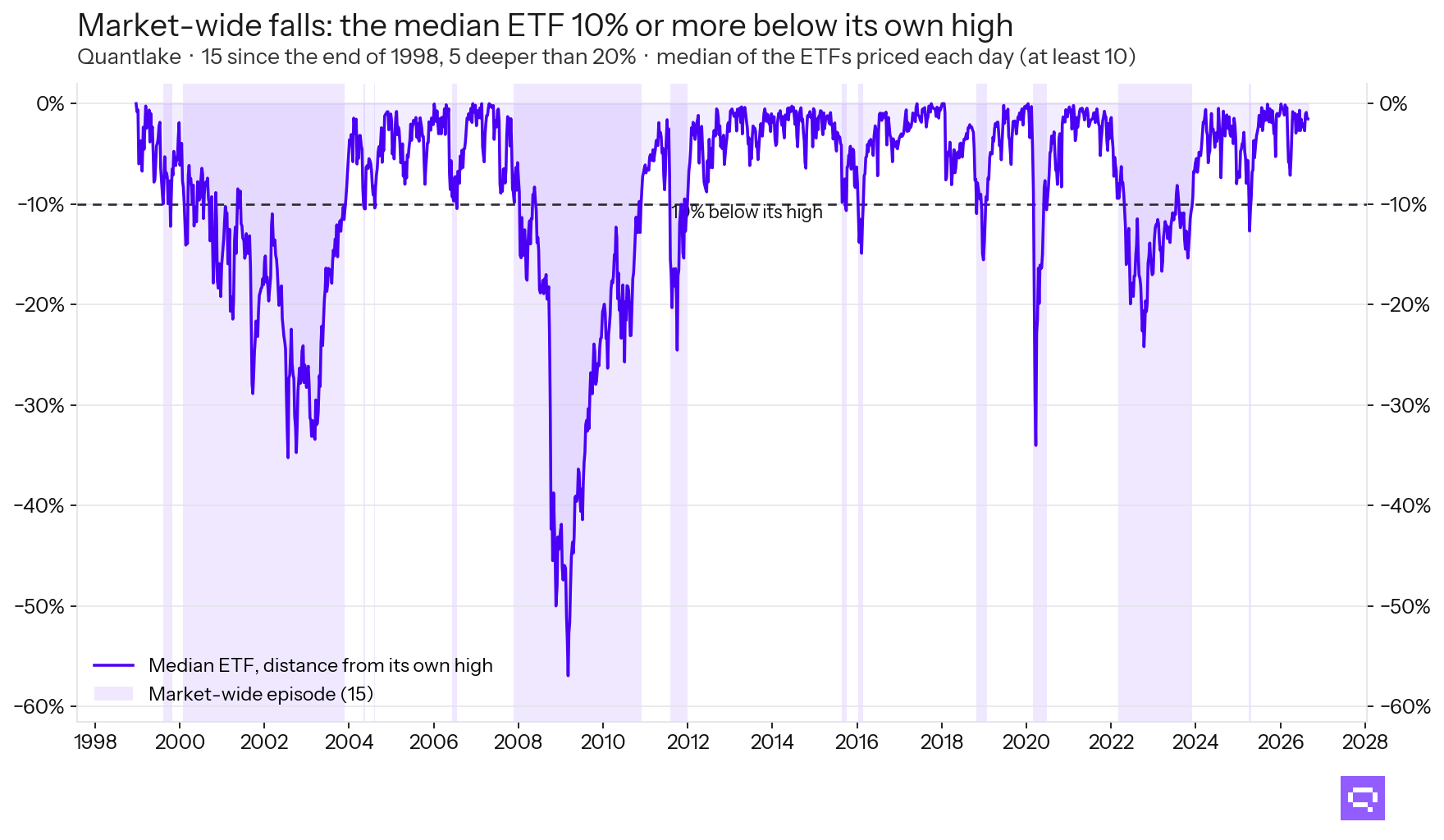
For ETF-oriented, long-term investors, the dominant risk is rarely short-term volatility. It is unforced behavioral error: panic selling during drawdowns, delaying investment due to fear, or chasing performance near market peaks. By enforcing consistency and reducing emotional interference, dollar-cost averaging directly targets these execution risks.
This logic also helps explain its institutional appeal. Automatic, non-discretionary investment plans generate steady capital inflows over time, particularly through retirement systems. While this should be viewed as a structural feature rather than a guaranteed stabilizing force, it underscores how behavioral design can shape aggregate investment behavior.
The lesson extends beyond dollar-cost averaging itself. The real value of the strategy lies not in the precise schedule, but in the discipline it enforces. Automation, rule-based execution, and pre-commitment are powerful tools precisely because they reduce reliance on willpower at moments when investors are most likely to falter.
Conclusion
The persistence of dollar-cost averaging is not a failure of financial theory, nor evidence of widespread irrationality. It reflects the reality that successful investing depends as much on managing behavior as on optimizing expected returns. A robust investment framework must bridge this gap—acknowledging that, in practice, strategies that investors can stick with often outperform those that are merely optimal on paper.
Happy Long-Term Investing!
Romain Gandon, CEO & Founder of Quantlake
🔗 LinkedIn