.png)

Dividend Leads as Breadth Improves; Duration Rebounds
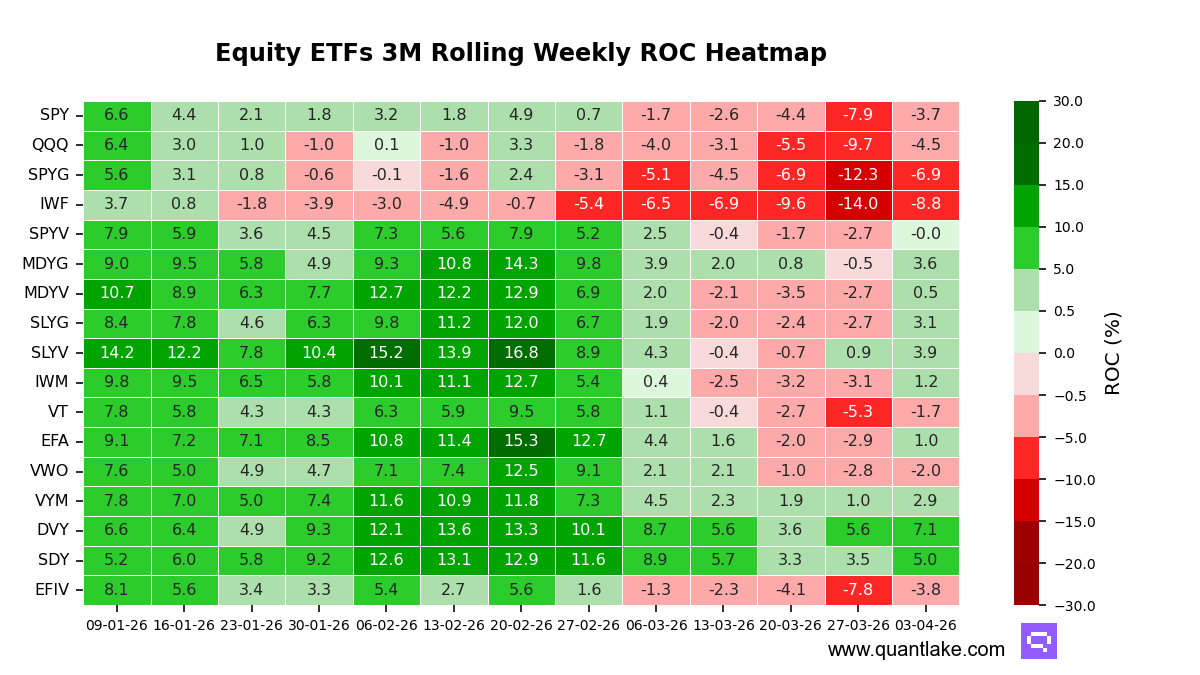
Dividend and value factors retained the lead in our equity universe, but the week’s tone broadened sharply versus the prior week as small-cap and mid-cap exposures rejoined the positive cluster. The growth complex remained the clear laggard, leaving leadership defensive even as participation widened.
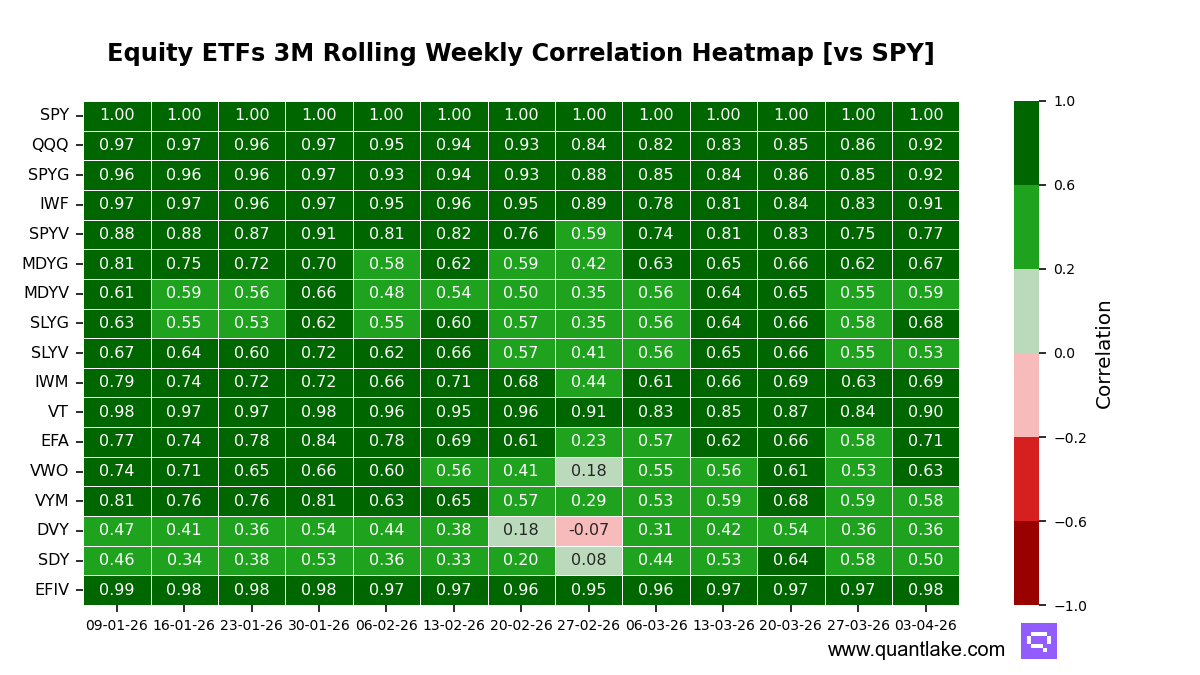
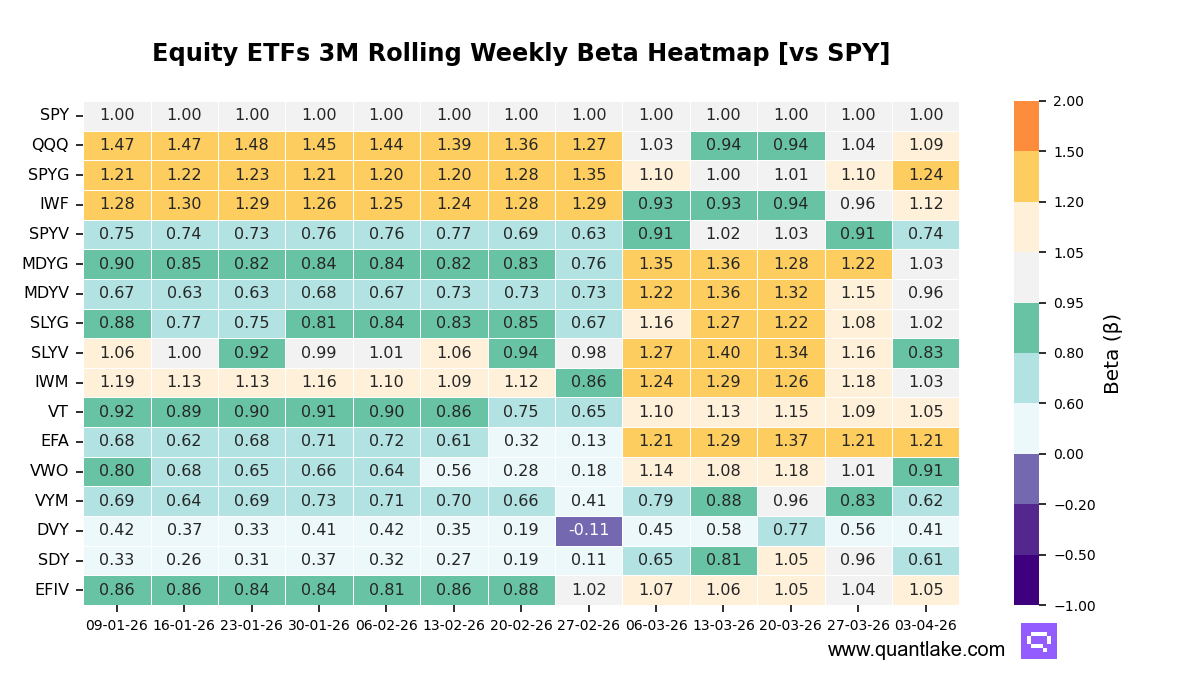
That mix looks less like a single benchmark trade: correlation to SPY for the key leaders sits below their 1-year mean alongside sizable alpha contribution. iShares Select Dividend ETF (DVY) shows correlation to SPY of 0.36 versus 0.65 with 8.6 points of alpha contribution, while SPDR S&P Dividend ETF (SDY) shows 0.50 versus 0.65 with 7.3 points of alpha.
This week, breadth improved decisively, with all 17 ETFs we track posting stronger 3-month trailing momentum versus the prior week. SPDR Portfolio S&P 600 Small Cap Growth ETF (SLYG) logged the strongest acceleration (Δ +5.8 points), followed by SPDR Portfolio S&P 500 Growth ETF SPYG (Δ +5.4) and Invesco QQQ Trust (Δ +5.2). Vanguard FTSE Emerging Markets ETF (VWO) improved least (Δ +0.8), while DVY (Δ +1.5) and SDY (Δ +1.5) also trailed on velocity despite remaining leaders in level terms. Five funds flipped positive: MDYG, MDYV, SLYG, IWM, and EFA.
In level terms, DVY and SDY sit in the top decile, with SLYV and MDYG in the upper third. SLYG and VYM are also above zero, while IWF, SPYG, and QQQ remain in the bottom decile.
Stress remains muted: no ETF is statistically stretched or depressed on our 1-year Z-score lens.
Leadership continues to look more idiosyncratic than beta-led. DVY and SDY pair lower correlation to SPY than their 1-year mean with large positive alpha contribution, consistent with improving internal dispersion. At the other end, IWF, SPYG, and QQQ show high correlation to SPY and negative alpha contribution, behaving more like beta proxies even as momentum recovers.
Our take: The prior week’s dividend-led, alpha-forward framework holds, and this week’s cross-style momentum acceleration marks a clearer participation upgrade without dislodging growth as the primary drag.
The fixed income complex we track moved from uniform weakness to broad-based repair over the week. Relative to the prior week’s baseline, leadership rotated toward duration while credit also firmed, leaving the curve picture less synchronized and more barbelled than it was.
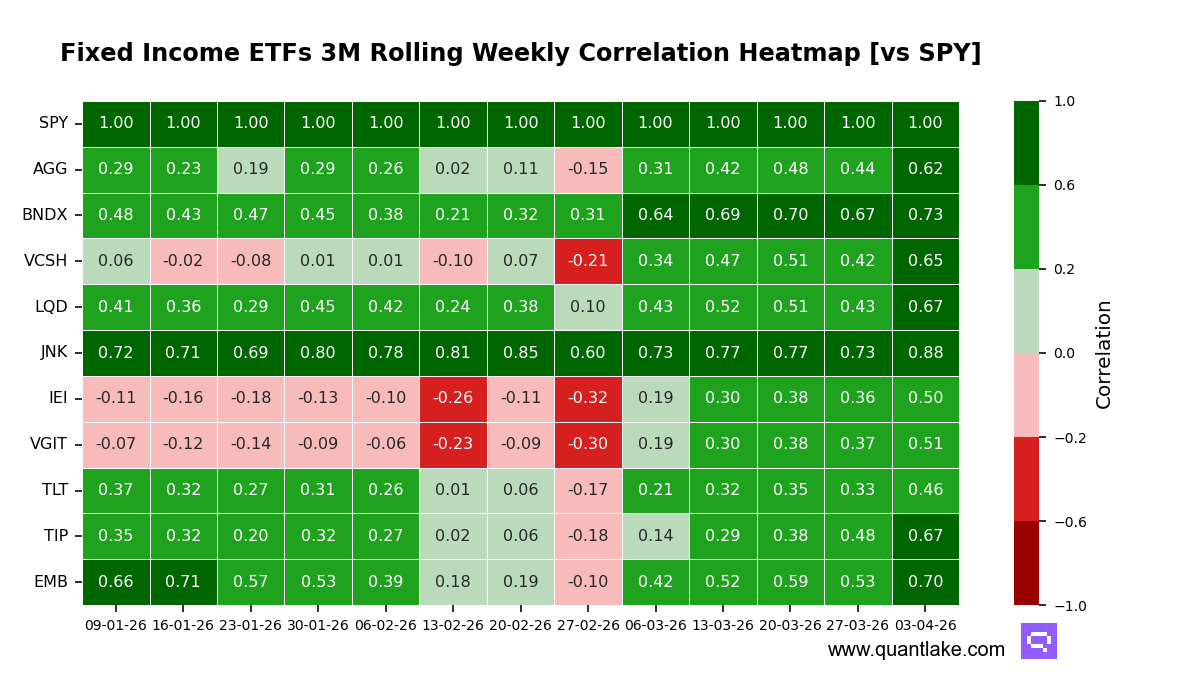
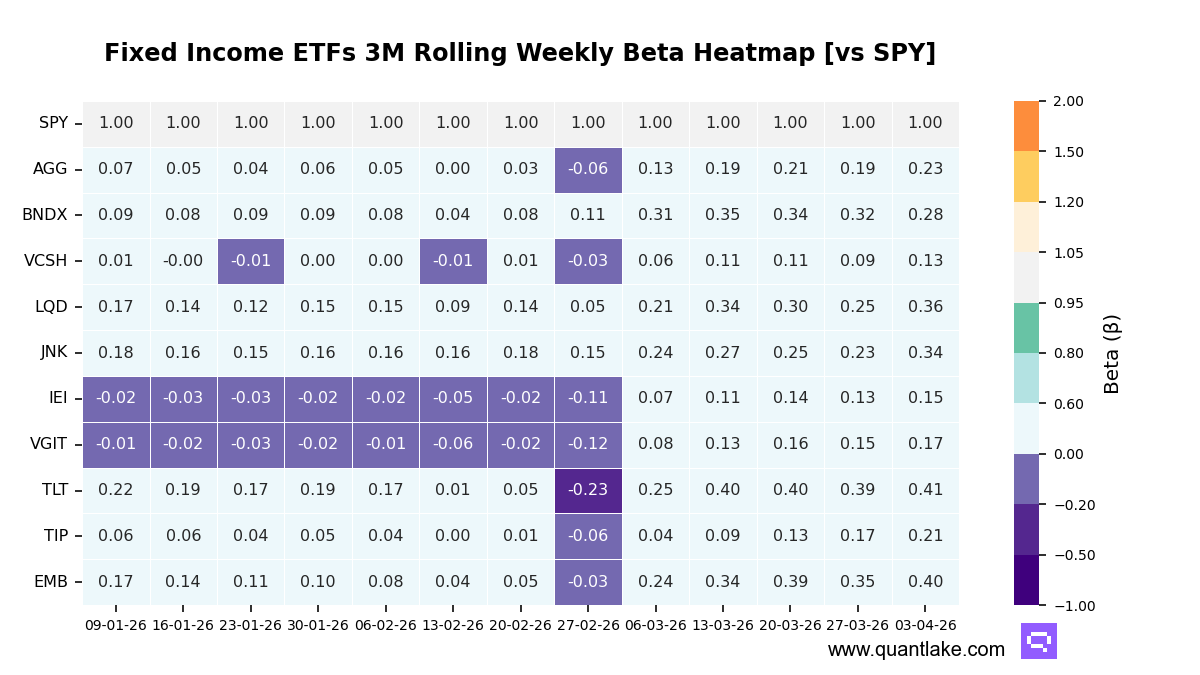
The linkage to the broad equity benchmark remains elevated across most sleeves versus their one-year norms, keeping the group more risk-on in its correlation profile than history implies. Long-duration Treasuries are the clearest case of convergence, with correlation at 0.46 versus a -0.09 one-year mean. High yield also sits at the high end of equity sensitivity, with correlation at 0.88 versus a 0.73 mean.
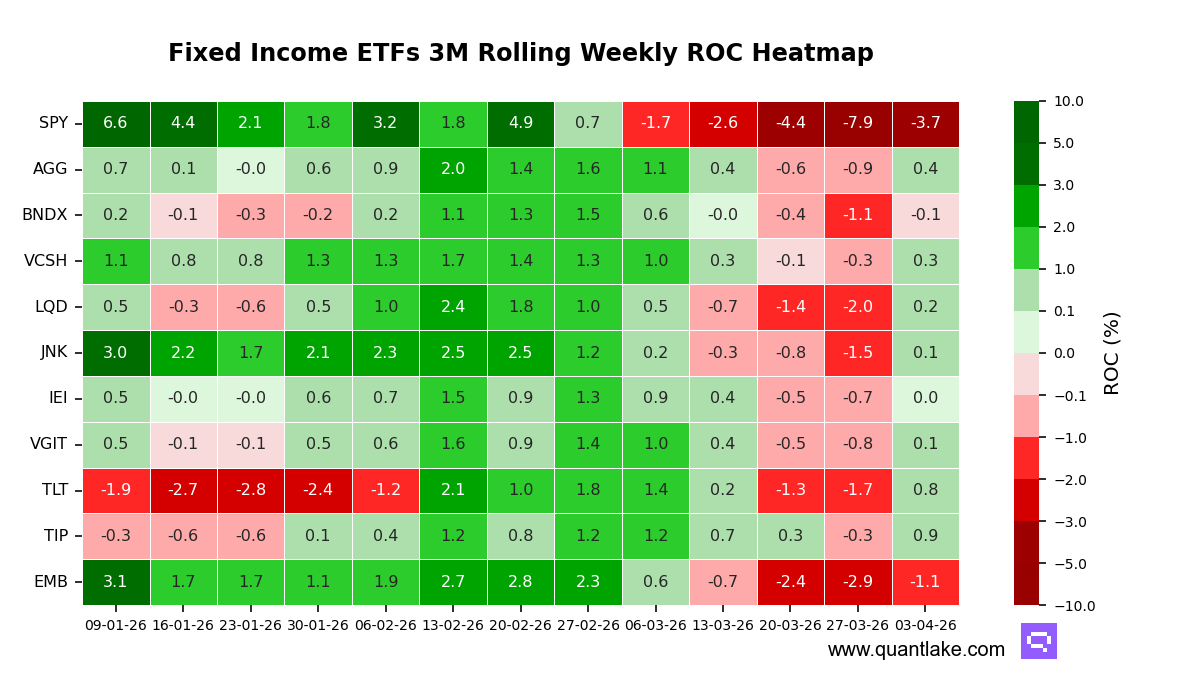
Across our universe, all 11 ETFs saw week-over-week momentum acceleration. The best relative movers were iShares 20+ Year Treasury Bond ETF (TLT) at +2.5 points, iShares iBoxx $ Investment Grade Corporate Bond ETF (LQD) at +2.2, and iShares JPMorgan USD Emerging Markets Bond (EMB) at +1.8. The smallest gains were Vanguard Short-Term Corporate Bond ETF (VCSH) at +0.6 points, iShares 3–7 Year Treasury Bond (IEI) at +0.7, and Vanguard Intermediate-Term Treasury ETF (VGIT) at +0.9. TLT, LQD, and VGIT flipped positive, alongside AGG, VCSH, JNK, and TIP.
In level terms, iShares TIPS Bond ETF (TIP) and TLT sit in the top decile, with iShares Core US Aggregate Bond ETF (AGG) in the upper third. VCSH and LQD are mid-pack, while BNDX and EMB sit in the lower half, with EMB in the bottom decile.
Stretch looks less binding than last week’s read. No fund screens beyond a two-standard-deviation extreme, though VCSH (-1.87) and EMB (-1.67) remain meaningfully depressed versus their own means—consistent with lingering normalization risk rather than clean trend persistence.
Our take: the prior week’s "least weak" framework is challenged by this week’s broad sign flips and duration-led acceleration, even as elevated equity linkage keeps the complex behaving less defensively than its history.